

Short answer: the Koolie (also called the Australian Koolie or German Koolie) is an Australian working dog bred from British collies and German working dogs. It is used to muster sheep, cattle and goats. Koolies are bred for working ability rather than the show ring, so individual dogs vary more than in a standardised breed.
For most households, the more useful question is whether you can give a herding dog real work: training, mental challenges, safe exercise and a plan for its instinct to gather and control movement. This guide covers where the breed comes from, what the merle coat means for health, and how to find a well-bred dog.
Koolie at a glance
| Origin | Australia, from British collie and German working-dog stock |
|---|---|
| Bred for | Working sheep, goats and cattle on farms and stations, on transports and in sale yards |
| Height (club guide) | Dogs 45–65 cm, bitches 43–60 cm at the wither, a wide range that reflects different working types |
| Coat | Close, flat outer coat with a short, dense undercoat; any colour, including merle and solid |
| Registration | Koolie Club of Australia register; sporting registers. Not a show-ring breed |
| Best suited to | Experienced, active owners with stock work, dog sports or a serious training habit |
Where the Koolie comes from
According to the Koolie Club of Australia's breed history, the Koolie developed from British working dogs, including blue merle and smooth-coated collies, that arrived with colonial settlers. German settlers also brought working dogs, sometimes called "Tigers", in the 1840s and 1850s, and these were bred with the British dogs.
The club explains that the name grew from "the German's Coolies". When the club formed in 2000, it chose the "K" spelling to help separate Koolies from Collies. That is why you will still hear "German Koolie", "Coolie" and "Australian Koolie" used for the same type of dog. If Australian breed names confuse you, our guide to why Australian dog breeds have different names explains the wider pattern.
Different jobs shaped different dogs. The club describes small, agile dogs for transport work, larger dogs with stamina for droving and high-country work, and steady dogs for handling sheep. The same variety explains the wide height range above.
Bred to work, not to win the show ring
The Koolie is not shown like a Kelpie or Border Collie. The Koolie Club of Australia says Koolies are recognised on sporting registers for competition, but it has "no plans" to seek recognition for the show ring. Breeders focus on working ability rather than appearance to avoid the problems that can follow when breeding centres on looks.
The club keeps its own register, with more than 1,900 registrations listed on its website. Instead of a show standard, it publishes Koolie Fundamentals, which describe a strong, athletic, well-muscled dog with a "balanced temperament, neither nervous nor aggressive, but bold and intelligent".
For a buyer, this matters in two ways. First, a "Koolie" label alone tells you less than a registered pedigree and health records. Second, dogs from busy working lines may want far more to do than a suburban routine can easily provide.
How Koolies work, and what that means at home
Koolies are versatile stock dogs. Published breed descriptions list several working styles: heading stock from the front, driving from behind, casting around a mob, blocking and, when needed, jumping onto the backs of sheep. They are often described as quiet, upright workers.
The Koolie Club notes that the breed also works in agility, tracking, therapy, rescue, quarantine and detection roles, and lives as a companion. That range is the real appeal: a Koolie can be a capable partner for an owner who enjoys training.
At home, the same instincts can show up as watching, circling, chasing or nipping at moving children, bikes and other pets. Plan for:
- daily exercise suited to the dog's age and fitness, plus sniffing walks and rest
- short reward-based training sessions and problem-solving games
- a regular outlet such as herding lessons, agility, tracking or scent work
- secure fencing and supervision around children and small animals
- teaching the dog to settle, so it does not depend on constant activity
Merle coats: the health question to ask
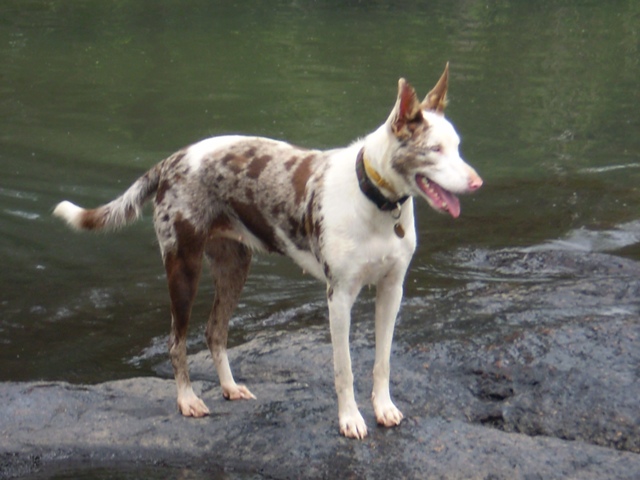

Many Koolies have a merle coat, a mottled pattern with patches of darker colour. Solid colours such as black, red and chocolate also occur. Merle is attractive, but it matters for health when two merle dogs are bred together.
The club's puppy buying guide warns that "double merle pups have the very real possibility of having sight and hearing issues", and recommends breeding a merle to a solid-coloured dog instead. Its Fundamentals give the same advice.
Ask any breeder: what colour are both parents, and have they been DNA tested? The club says breeders who follow its code of ethics health-test their dogs, and that you should ask to see current results.
Is a Koolie the right dog for you?
The Koolie Club is candid that "some dogs that are bred to work will not suit life in a backyard". A good breeder will try to match the puppy to your plans, whether you want a working dog, a sports partner or a family companion.
A Koolie may suit you if:
- you have livestock work, or you will commit to a dog sport or regular training class
- you enjoy teaching new skills and see training as part of your day
- you have secure fencing and time to supervise around children and other pets
- you can plan exercise around Australian heat
Think carefully if you are away for long hours, want a mostly relaxed companion or have little time for training. The RSPCA's pre-pet checklist is a good reality check on time, costs and long-term commitment. Our guide to dogs for active people and first-time owner guide cover other options.
Every working dog needs care in heat. RSPCA heatstroke advice recommends exercise in the coolest parts of the day, constant access to water and shade, and avoiding hot surfaces. A keen herding dog may not stop on its own, so you need to call the break.
Koolie, Kelpie, Border Collie or Cattle Dog?
Our Koolie breed profile rates its energy, trainability and family fit on the same scale as other breeds. These Australian favourites overlap, but they are not interchangeable:
- The Australian Kelpie is a recognised breed with a published standard and a strong reputation for independent sheep work.
- The Border Collie is often very handler-focused and sensitive to movement.
- The Australian Cattle Dog is a sturdy cattle specialist with a very different build and coat.
- The Australian Shepherd is a separate, recognised breed that also often carries merle, so the same colour-breeding questions apply.
Our Kelpie vs Border Collie and Border Collie vs Australian Shepherd comparisons go into more detail. Whichever you choose, the individual dog's line and upbringing matter as much as the breed name.
Finding a Koolie
Start with breeders registered with the Koolie Club of Australia. The club suggests asking: "Are you a registered breeder with the Koolie Club of Australia and will these pups be registered?" Questions worth adding:
- Can I meet the mother, and the father if possible?
- What colour are both parents, and what DNA health tests have they had?
- Do the parents work stock, compete in sports or live as companions?
- How have the puppies been socialised with people, children, other dogs and everyday noises?
- Will the puppy be vet-checked, vaccinated, wormed and microchipped before going home?
Adult Koolies and Koolie crosses sometimes come through rescue groups. An assessed adult can be a great option, because its energy, size and behaviour around children and other pets are already partly known.
Not sure a herding dog fits your week? Our free dog breed matching quiz compares your home, routine and experience with breed traits, so you can see which dogs suit the life you actually have.
Koolie FAQs
Is a Koolie the same as a Kelpie?
No. Both are Australian herding dogs with British collie ancestry, but they are separate types. The Kelpie is a recognised breed with a published standard. The Koolie is defined by its club and bred mainly for working ability, and is often merle.
Why is it called a German Koolie?
The Koolie Club traces the name to "the German's Coolies", reflecting working dogs kept by German settlers. The club adopted the "K" spelling in 2000 to set the breed apart from Collies.
Is the Koolie a recognised breed?
Koolies are registered by the Koolie Club of Australia and accepted on sporting registers, but they are not shown like recognised show breeds. The club says it has no plans to seek show-ring recognition.
Do Koolies make good family pets?
They can, in an active household that provides training, mental work and supervision. Herding instincts can lead to chasing or nipping at running children, so manage early and choose a puppy or adult dog matched to family life.
How big do Koolies get?
The club's guide gives a height of 45–65 cm for dogs and 43–60 cm for bitches. Working lines vary, so the parents are the best guide to a puppy's likely adult size. Once you have a puppy, our puppy growth calculator can estimate its adult weight from its age and current weight.
Do Koolies shed?
Yes. Koolies have a short, dense undercoat under a flat outer coat, so expect some shedding and regular brushing.
Sources and further reading
- Koolie Club of Australia: Koolie history
- Koolie Club of Australia: Koolie Fundamentals
- Koolie Club of Australia: Choosing a puppy
- Wikipedia: Koolie
- RSPCA Knowledgebase: What to know before getting a pet
- RSPCA Knowledgebase: Protecting your dog from heatstroke
Cover photo: Koolies on cattle by Tjukurpa Koolie Club of Australia, Wikimedia Commons, CC BY-SA 3.0.
