
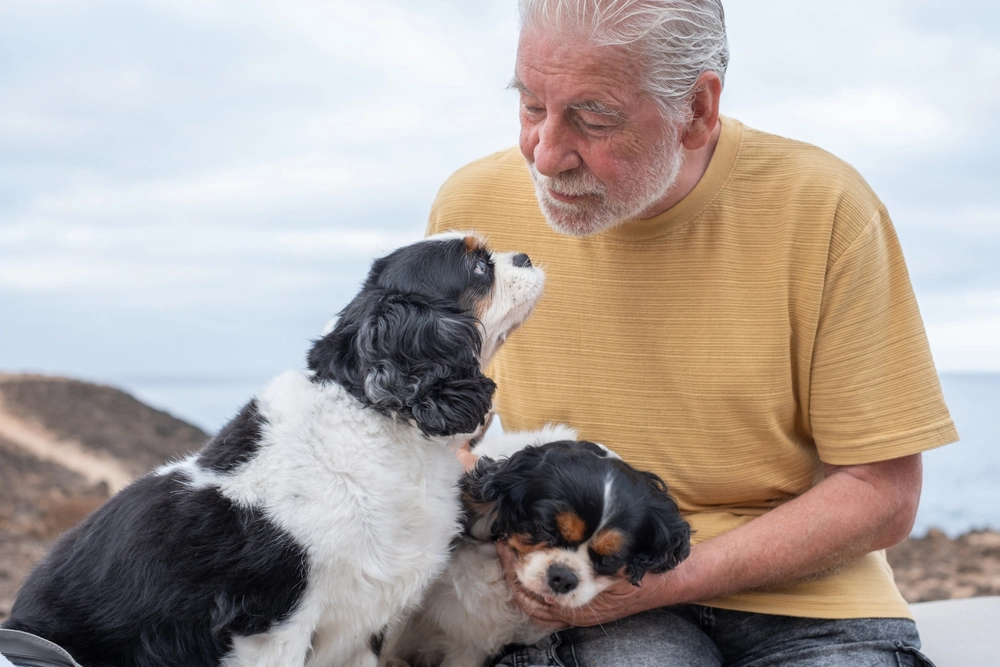
The question is not which dog is the easiest. It is which dog will genuinely fit your life. A dog that lies on the couch all day is not automatically a good match for someone who walks 45 minutes every morning. And a dog that bonds deeply with one person is not a burden — for a senior living alone, it may be exactly what makes each day feel purposeful.
What changes as you get older is not the desire for a dog. It is the practical reality of living with one. Weight matters more when you are managing a lead. Grooming costs add up on a fixed income. Heat sensitivity in a breed is a real concern in an Australian summer. This guide works through the breeds that score best on the factors that actually matter for senior owners — with honest trade-offs for each.
What Seniors Should Look for in a Dog
Energy level matched to your real activity level — not your aspirational one — A dog that needs two hours of hard exercise daily will not thrive on 30-minute walks, no matter how much you intend to do more. Be honest about your current routine, not the one you plan to start.
Size and weight — A small dog that pulls is a minor inconvenience. A 30 kg dog that pulls can cause a real fall. Beyond the lead, smaller dogs are easier to lift into the car, cheaper at the vet (many medications and procedures are weight-dependent), and more manageable if your mobility changes over time.
Grooming demands — A breed requiring professional grooming every 6 to 8 weeks is a real scheduling and cost commitment. If grooming is a burden, a short-coated breed is worth prioritising even if you love the look of a longer-coated dog.
Separation anxiety — and why it may work in your favour — Breeds prone to separation anxiety bond deeply and need company. For a senior who is home most of the day, this is often a positive. A dog that wants to be near you is a companion, not a problem. The concern only applies if travel or medical appointments mean extended time away.
Heat tolerance in the Australian climate — This matters more than most breed guides acknowledge. Brachycephalic breeds — French Bulldogs, Pugs, English Bulldogs — score 1/5 for heat tolerance. An Australian summer is genuinely dangerous for these dogs, and their vet costs reflect it. Breeds that handle heat well give you far more flexibility.
The 6 Best Breeds for Senior Owners
| Breed | Energy | Training | Grooming | Barking | Apartment |
|---|---|---|---|---|---|
| Cavalier King Charles Spaniel | 3 / 5 | 5 / 5 | 3 / 5 | 2 / 5 | 5 / 5 |
| Maltese | 2 / 5 | 4 / 5 | 4 / 5 | 4 / 5 | 5 / 5 |
| Moodle | 3 / 5 | 4 / 5 | 4 / 5 | 3 / 5 | 5 / 5 |
| Shih Tzu | 2 / 5 | 3 / 5 | 5 / 5 | 3 / 5 | 5 / 5 |
| Boston Terrier | 3 / 5 | 4 / 5 | 2 / 5 | 2 / 5 | 5 / 5 |
| Italian Greyhound | 3 / 5 | 3 / 5 | 1 / 5 | 3 / 5 | 5 / 5 |
Cavalier King Charles Spaniel

The Cavalier was bred for one purpose: to be a companion. It scores 5/5 for training ease and 2/5 for barking, adapts to apartments or houses with equal ease, and is content with a moderate daily walk. It does not demand more than you can give, and it gives back considerably more. For a senior owner living alone, the Cavalier's instinct to be close to its person is not separation anxiety — it is devotion.
Weight ranges from 6 to 8 kg — light enough to manage easily but substantial enough to feel like a real dog. Grooming is moderate: a silky coat that needs brushing several times a week but only occasional professional trimming.
One honest caveat: Heat tolerance is 1/5. In Australian summers, Cavaliers need air conditioning and cannot be left in warm cars or direct sun. This is manageable indoors but requires planning during hot months.
Maltese

At 2 to 3 kg, the Maltese is one of the lightest breeds available — easy to lift, inexpensive to feed, and lower vet costs across the board. Energy is genuinely low (2/5) and heat tolerance is 4/5, which makes it one of the better small breeds for warm Australian climates. It scores 4/5 for trainability, responding well to positive reinforcement, and 5/5 for apartment suitability.
The Maltese tends to bond very closely with one person — which for a senior living alone is often exactly the right temperament.
One honest caveat: Grooming demands are high (4/5) and barking is 4/5. The long white coat requires daily brushing and regular professional grooming. Many owners keep it in a short clip, which reduces the grooming burden considerably. Early training helps manage the barking.
Moodle

The Moodle (Maltese × Poodle) takes the Maltese's compact size and low energy and pairs it with the Poodle's trainability and low-shedding coat. The result is a 2 to 7 kg dog that scores 4/5 for training ease, 3/5 for barking (an improvement on the Maltese), and 5/5 for apartment suitability. For seniors who want the Maltese temperament with a more trainable, quieter disposition, the Moodle is the natural choice.
The low-shedding coat is a genuine advantage for those with mild allergies or who prefer a cleaner home.
One honest caveat: Like the Maltese parent, the Moodle's coat needs regular professional clipping. It does not shed, but it does not self-maintain either. Budget for grooming every 6 to 8 weeks.
Shih Tzu
The Shih Tzu was bred for Chinese imperial courts — a lap dog in the purest sense. It scores 2/5 on energy, does not need hard exercise, and is perfectly content with a gentle daily walk and a warm spot on the couch. It scores 5/5 for apartment suitability, 3/5 for barking, and is genuinely affectionate and sociable. For a senior who wants a calm, decorative companion, it delivers.
One honest caveat: Grooming is 5/5 — the highest maintenance coat on this list. The long flowing coat mats without daily brushing and requires professional grooming every 4 to 6 weeks. Many owners keep Shih Tzus in a short puppy clip, which makes management far more practical. Heat tolerance is also 2/5, so summer shade and airflow are important.
Boston Terrier
The Boston Terrier is the sleeper pick on this list. It scores 2/5 for both grooming and barking — among the lowest of any companion breed — and 4/5 for training ease. Short-coated, clean, and quiet, it is one of the most practically low-maintenance dogs available. Weight ranges from 5 to 11 kg, energy is moderate (3/5), and it thrives in apartments (5/5).
Bostons are sociable and playful without being overwhelming. They enjoy a daily walk but do not demand more than that.
One honest caveat: Like the French Bulldog and Pug, the Boston Terrier is a brachycephalic breed — a flat face that restricts airflow. Heat tolerance is 1/5. In Australian summers this matters: keep it cool, avoid midday walks, and ensure it always has shade and water. Vet costs can be higher than for non-brachycephalic breeds.
Italian Greyhound
The Italian Greyhound is an unexpected but genuinely excellent senior dog. At 3 to 5 kg, it is one of the lightest breeds on this list. Its grooming score is 1/5 — the lowest possible, a wash-and-go short coat that needs almost no maintenance. Heat tolerance is 5/5, which makes it one of the few truly heat-suited companion breeds for Australian conditions. It scores 5/5 for apartment suitability and is naturally quiet.
Despite being a sighthound with sprint capability, Italian Greyhounds are actually quite content with moderate daily exercise — they love a sprint, then they love a warm lap. They form deep bonds with their owners and thrive as companion dogs.
One honest caveat: Italian Greyhounds are fragile. Their fine bone structure means they can injure themselves jumping off furniture. They also feel the cold acutely (cold tolerance 2/5) and need a coat in winter — which is a minor practical consideration in most of Australia but relevant in southern states.
Honourable Mention: Retired Racing Greyhounds
The full-sized Greyhound deserves a mention here, even though its 27 to 40 kg weight puts it outside the easy-handling range for many seniors. Retired racing Greyhounds score 3/5 on energy — they are genuinely low-energy dogs that need one decent daily walk, not continuous stimulation. Grooming is 1/5. Barking is 2/5. Apartment suitability is 5/5. Heat tolerance is 5/5.
For a senior with a manageable home, no mobility issues, and an interest in adoption, a retired Greyhound is one of the most rewarding choices available. They arrive calm, socialised, and settled — not a puppy project. Australian Greyhound adoption organisations have significant numbers of dogs available at any time.
Breeds to Reconsider
French Bulldog, Pug, and English Bulldog
All three are perennially popular small breeds, and all three score 1/5 for heat tolerance. In an Australian summer, a brachycephalic dog that overheats quickly is a genuine welfare and safety concern. They also carry elevated vet costs due to breathing issues, skin fold infections, and eye conditions — costs that compound over time. For a senior on a fixed income in a warm climate, these breeds carry more risk than their temperament advantages justify.
Jack Russell Terrier
The Jack Russell has enormous energy and determination packed into a small body. It scores 4/5 on energy and needs significant daily exercise and mental stimulation. An under-exercised Jack Russell becomes destructive and loud. This is a breed for active owners who can match its pace — not a natural fit for a quieter senior household.
Border Collie
Highly intelligent and highly demanding. A Border Collie without structured work and stimulation develops anxiety and compulsive behaviours. Even for active seniors, the mental engagement a Border Collie requires daily is a significant commitment.
A Note on Adopting an Older Dog
A senior owner and an older rescue dog can be an excellent pairing. A 5 to 8 year old dog from a shelter is typically toilet-trained, past the destructive puppy phase, and with a settled temperament you can actually assess before you commit. Many older dogs in shelters are there through no fault of their own — a family move, an owner's health change, a lifestyle shift. They are not problem dogs. They are experienced dogs looking for a quiet, consistent home — which is exactly what many senior owners can offer.
The honest consideration is lifespan: a 7 year old dog may live another 7 to 10 years depending on the breed. That is a meaningful commitment, but it is also 7 to 10 years of daily companionship.
Not Sure Which Breed Suits Your Life?
Our quiz takes your home type, activity level, household, and preferences and matches them against every breed in our database — including all six breeds listed here.
Take the breed matching quiz →
Frequently Asked Questions
What is the best dog breed for an elderly person?
There is no single best breed — it depends on your living situation, activity level, and whether you want a very small dog or something slightly larger. The Cavalier King Charles Spaniel consistently rates as one of the best all-round companion breeds for seniors: gentle, trainable, quiet, and apartment-suited. For those who want lower grooming and better heat tolerance, the Italian Greyhound or Moodle are strong alternatives.
Are small dogs better for seniors?
Generally yes, for practical reasons: lower vet costs, easier to lift and manage on a lead, and typically less physically demanding than large breeds. But small does not mean easy — a Jack Russell Terrier is small and extremely demanding. The better filter is energy level, trainability, and grooming needs, not size alone.
Should a senior get a puppy or an older dog?
An older dog is often the better choice. A 4 to 7 year old rescue dog is toilet-trained, past the destructive puppy phase, and has a known temperament. Puppies require intensive time and energy in the first 12 months — early training, socialisation, and close supervision — that does not always align with a senior's lifestyle. An adult dog from a reputable shelter or rescue skips most of that.
What dogs are good for seniors with allergies?
Low-shedding breeds reduce the airborne dander that triggers most dog allergies. The Moodle, Maltese, and Italian Greyhound are all low-shedding options on this list. No breed is fully hypoallergenic — the allergen is a protein in dog saliva and skin, not just the hair — but low-shedding breeds significantly reduce exposure for most allergy sufferers. See our full guide on what hypoallergenic actually means for more detail.