
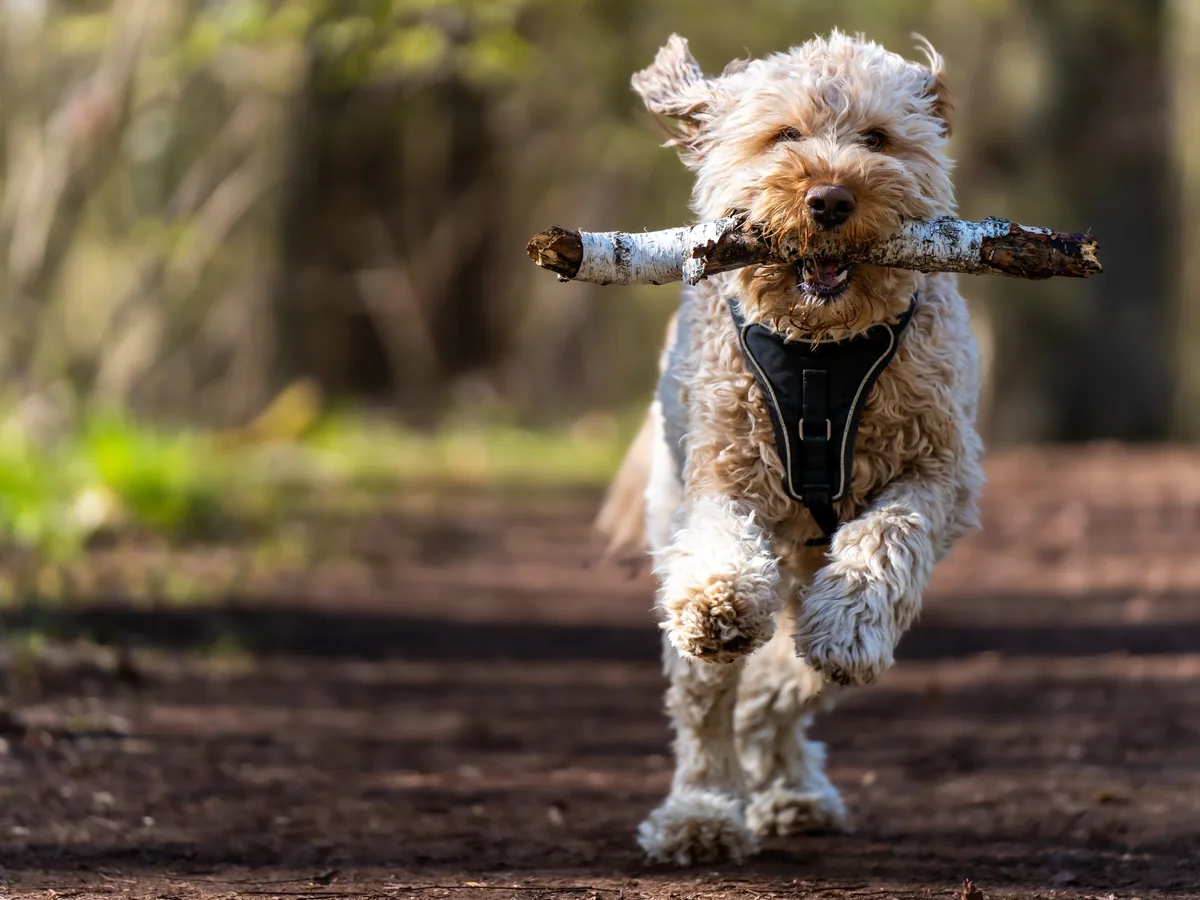
The Groodle — known internationally as the Goldendoodle — emerged in Australia in the late 1980s as an attempt to combine a Golden Retriever’s temperament with a Poodle’s lower-shedding coat for service work. It quickly became something else entirely: one of the most popular family dogs in the world. That popularity isn’t an accident. These are genuinely excellent dogs, and when bred well, they deliver consistently on their reputation.
The social warmth of the Golden Retriever is fully intact. Goldendoodles are friendly with everyone, family, strangers, children, other dogs. They approach the world with an openness that makes them immediately likeable and entirely useless as guard dogs. They’re not suspicious. They’re not territorial. They’re delighted to see you and almost everyone else.
With children they’re outstanding. Patient, playful, gentle, and resilient enough to handle the energy and unpredictability of family life without getting rattled. It’s one of the reasons families choose them, and it holds up in real-world conditions.
They’re trainable to a high standard. The Poodle’s intelligence combines with the Golden’s desire to please to produce a dog that enjoys learning and responds quickly to positive reinforcement. This makes early training genuinely enjoyable rather than a test of patience, and it means they can develop into well-mannered, highly responsive dogs with the right investment.
The coat requires maintenance. Depending on which parent they take after, it can range from loose waves to tight curls. Either way, regular brushing is essential to prevent matting, and professional grooming every six to eight weeks keeps it under control. The lower-shedding reputation is real, but it comes with a trade-off. You’re swapping hair on the couch for time and money at the grooming table.
Energy is substantial and shouldn’t be underestimated. These are active dogs that need proper daily exercise, a run, a swim, or sustained play, not just a slow walk around the block. In the right home with active owners, this is a strength. In a sedentary household with limited space, it becomes a problem quickly.
They’re also strongly people-oriented. Leave them alone for long stretches without enough exercise or structure and they can become anxious or destructive. Like most smart, social dogs, they do best when they’re included in daily life, not parked on the sidelines.