
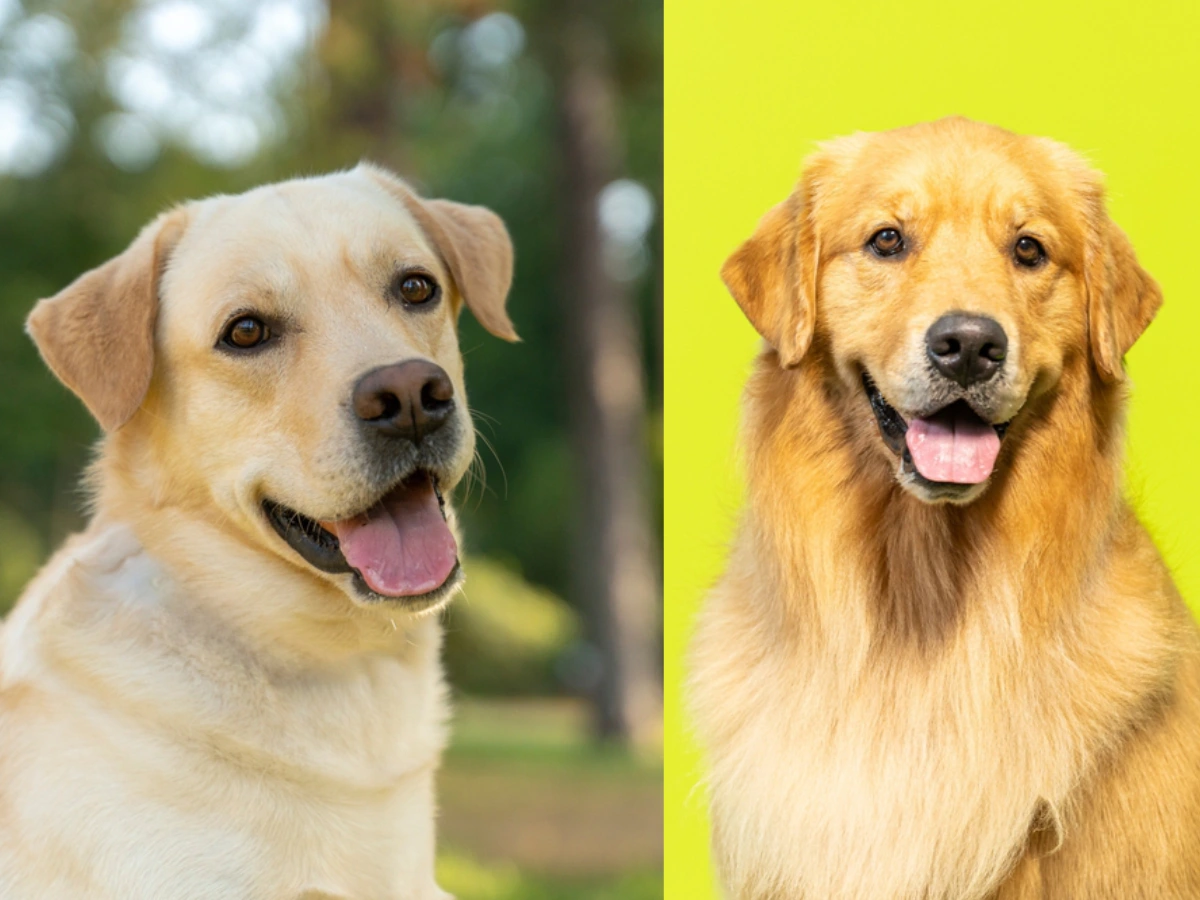
The Labrador Retriever and the Golden Retriever are the two most popular dog breeds in Australia, the United States, and the United Kingdom — and they have held that position for decades. They are both large, friendly, highly trainable, and excellent with children. If you are trying to choose between them, the honest answer is that you cannot go wrong with either.
But they are not the same dog, and the differences matter. Here is how they actually compare.
The Quick Answer
Both breeds score identically on the traits most people care about — friendliness with children, ease of training, sociability with other pets, and energy level. The meaningful differences come down to coat management, temperament nuance, working line variation, and how they handle Australian heat.
If you want the shorter-coat, more boisterous, food-driven option: Labrador Retriever.
If you want the softer, more emotionally attuned companion who needs more brushing: Golden Retriever.
Where They Are Identical
Before getting into the differences, it is worth being clear about what is genuinely the same:
- Friendliness with kids — both score 5/5. These are two of the most reliably child-safe breeds in existence.
- Training ease — both score 5/5. Both absorb commands quickly and respond well to positive reinforcement. Labs and Goldens are the most common breeds used as guide dogs and assistance dogs for exactly this reason.
- Sociability with other pets — both score 5/5. Neither breed has significant dog-aggression tendencies.
- Energy level — both score 4/5. Both need 60–90 minutes of genuine daily exercise, not just a stroll around the block.
- Separation anxiety risk — both score 4/5. Neither breed handles being alone all day well.
- Lifespan — both average 10–12 years.
- Size — both are large dogs in the 25–36 kg range, standing around 54–62 cm at the shoulder.
If your decision rests on any of the above factors, a coin flip would honestly be a reasonable method of choosing.
Where They Actually Differ
Coat and Grooming
This is the most practically significant difference for most households.
The Labrador has a short, dense double coat. It requires minimal brushing — a weekly once-over is generally enough outside of shedding season. The trade-off is shedding volume: Labs shed a lot, consistently, year-round. If you have dark furniture or wear dark clothing, you will notice. Their grooming score sits at 3/5 — moderate effort required, but mostly just vacuuming.
The Golden Retriever has a longer, feathered double coat that requires more active grooming — brushing several times a week to prevent matting, and extra attention to the ears, chest, and legs where the coat grows thickest. Their grooming score is 4/5. Shedding is substantial too, but slightly less intense than a Lab's. Professional grooming a few times a year is worthwhile.
Neither is low-maintenance. But if forced to choose: Labs are easier to groom day-to-day; Goldens are slightly easier on your furniture and dark clothing.
Temperament Nuance
Both breeds are friendly, affectionate, and people-oriented. But there is a real difference in how they express it.
Labradors tend to be more exuberant and boisterous — physical, enthusiastic, and in-your-face about it. They are intensely food-motivated, which makes training almost absurdly easy but also means they will eat anything within reach and gain weight quickly if diet and exercise are not actively managed. Labs can be genuinely hard work to settle down before the age of three, and puppies especially are mouthy, bouncy, and relentless.
Golden Retrievers are equally affectionate but tend to be softer in temperament — more emotionally tuned in, more likely to read the mood of the room. People often describe their Goldens as almost empathetic dogs. They are still enthusiastic and playful, but there is less of the "bull at a gate" energy that young Labs are known for. For households with very young children or elderly family members, that slightly softer edge matters.
Working Lines vs Show Lines (Labs Only)
This distinction matters more for Labs than Goldens. The Labrador comes in two noticeably different types: working lines (sometimes called field or American Labs) and show lines (sometimes called English Labs). Working-line Labs are leaner, more energetic, higher drive, and considerably more demanding. Show-line Labs are calmer, stockier, and much more forgiving in a family home.
If you are buying a Labrador puppy, ask the breeder which line the litter comes from. A working-line Lab placed in a household that does not do dog sports or substantial outdoor activity can become a genuinely difficult dog to live with. Show-line Labs are far more forgiving.
Goldens do have some variation between field and bench lines, but it is generally less extreme and less likely to catch a first-time owner off-guard.
Coat Colours
Labs come in three colours: yellow, black, and chocolate. Goldens come in shades of gold only — from pale cream to deep golden red.
One important note on chocolate Labs: research suggests chocolate Labradors have a slightly shorter average lifespan than black or yellow Labs — around 10 years versus closer to 12. The exact mechanism is not fully understood, but it is worth knowing if you are drawn to the colour.
Hot Weather Performance
For Australian owners in particular, this is worth factoring in. The Golden Retriever's double coat evolved for the Scottish Highlands — cold, damp, overcast. In sustained Australian summer heat, they can struggle. Shade, fresh water, and air conditioning on hot days are more important than many first-time owners anticipate.
Labradors handle heat slightly better — their shorter coat gives them less insulation to fight through — but both breeds are fundamentally cold-climate working dogs. Neither was designed for 38-degree afternoons in a Queensland backyard.
Who Each Breed Suits

Choose a Labrador Retriever if:
- You want shorter day-to-day coat maintenance
- You are drawn to the food-driven, always-up-for-anything energy
- You are interested in dog sports, working activities, or field work
- You want a choice of coat colour (yellow, black, or chocolate)
- You live somewhere with warmer summers and want a slightly more heat-tolerant option

Choose a Golden Retriever if:
- You want a softer, more emotionally gentle temperament
- You are happy to commit to regular brushing and occasional professional grooming
- You want a slightly calmer puppy and adolescent period
- You live in a temperate climate where extreme summer heat is not a regular factor
- You have very young children or elderly household members who would benefit from a gentler energy
What Both Breeds Need
Regardless of which you choose, the core lifestyle requirements are the same:
- Space — both score 2/5 for apartment friendliness. A house with a yard is strongly preferred. They can adapt to apartments with enough outdoor exercise, but it takes real commitment.
- Exercise — at least 60–90 minutes of genuine daily activity. Swimming, fetching, and running suit both breeds well.
- Company — both have high separation anxiety risk. Neither is a breed for households where the dog will be home alone most of the day.
- Early training — both are easy to train, but both grow into large dogs. Starting from day one, with consistent positive reinforcement, pays dividends for years.
The Bottom Line
Both the Labrador and the Golden Retriever are genuinely excellent family dogs with almost identical profiles on the traits that matter most. The decision comes down to coat preference, temperament feel, and whether you want the slightly more boisterous Lab or the slightly softer Golden.
If you are still undecided, our breed matching quiz takes about three minutes and compares your lifestyle against every breed in our database — including both of these. It will not just help you choose between retrievers; it will surface every compatible option.
You can also read the full breed profiles: Labrador Retriever and Golden Retriever.
Frequently Asked Questions
Is a Labrador or Golden Retriever better for families?
Both score 5/5 for friendliness with children and are among the most reliably family-safe breeds in the world. Neither is objectively better — it depends on temperament preference (Labs are more boisterous; Goldens are softer) and how much grooming time you have.
Which sheds more — a Lab or a Golden Retriever?
Labradors shed more by volume (5/5 vs 4/5). Their short coat means fine hairs work their way into everything. Golden Retrievers shed heavily too, but slightly less intensely — though their longer coat requires more active brushing to prevent matting.
Are Labradors easier to train than Golden Retrievers?
Both score 5/5 for training ease — they are essentially equal. Labs respond especially well to food rewards; Goldens respond well to both food and praise. Either breed makes training a largely enjoyable experience, even for first-time owners.
Which handles Australian heat better — a Lab or a Golden?
Labradors cope slightly better due to their shorter coat, but neither breed is well-suited to extreme heat. Both are double-coated cold-climate working dogs. In Australian summers, both need shade, water, and access to air conditioning on hot days.
Do Labradors or Golden Retrievers live longer?
Both average 10–12 years with no significant difference between the breeds. Within the Labrador breed, chocolate Labs tend to have slightly shorter average lifespans (around 10 years) than black or yellow Labs.
Which is calmer — a Labrador or a Golden Retriever?
Golden Retrievers are generally considered slightly calmer and less boisterous, particularly as puppies and young adults. Working-line Labradors especially can have an intense, relentless quality that takes several years to settle. That said, both are energetic, retrieving-bred dogs — neither is calm in any absolute sense.